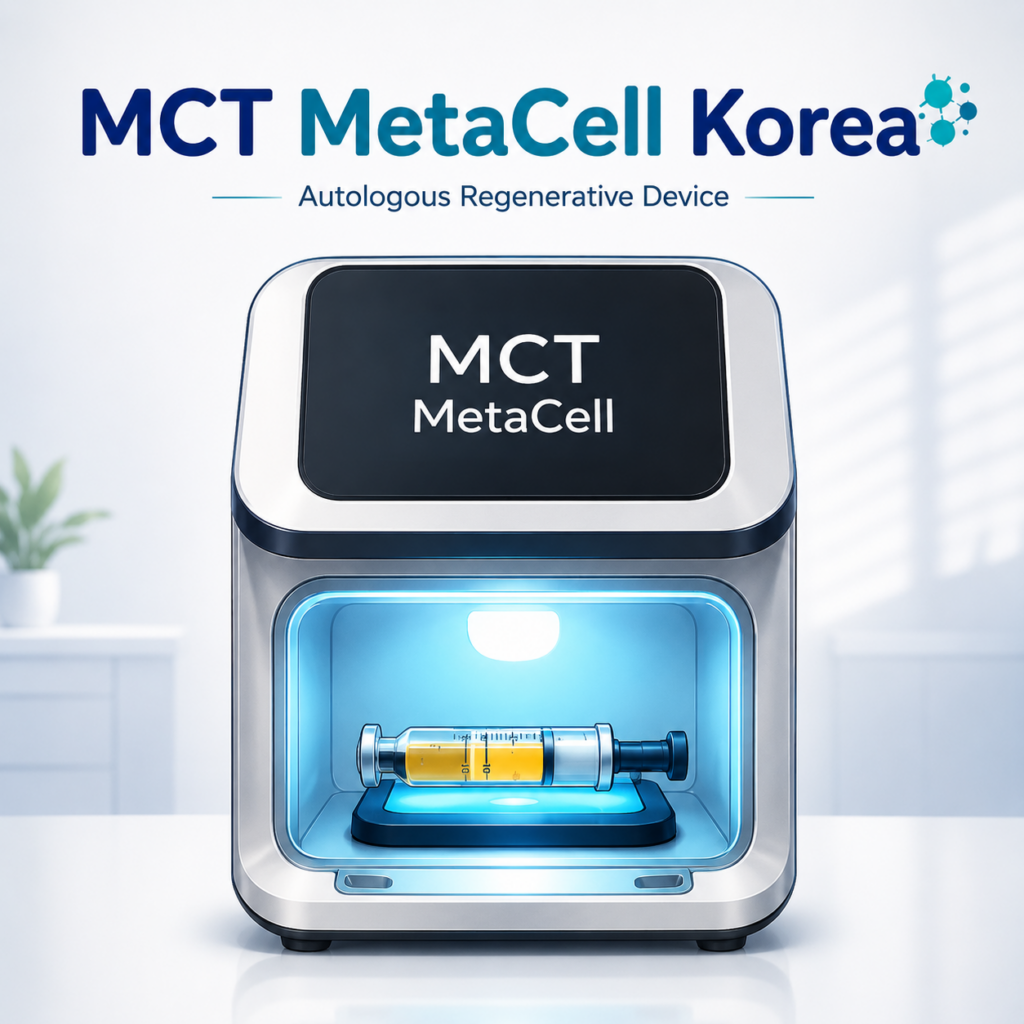
MCT MetaCell Korea is an autologous regenerative skin treatment concept that uses the patient’s own blood-derived components, Zimmer Biomet platelet concentration kit preparation, and MCT photothermal conditioning to support skin quality, recovery, texture, and regenerative signaling.
Unlike filler or a simple skin booster, MCT MetaCell Korea is not mainly designed for immediate volume correction. It is better understood as a regenerative treatment that uses autologous bioactive material to support the skin’s recovery environment and long-term skin quality.
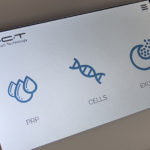
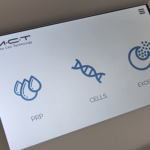
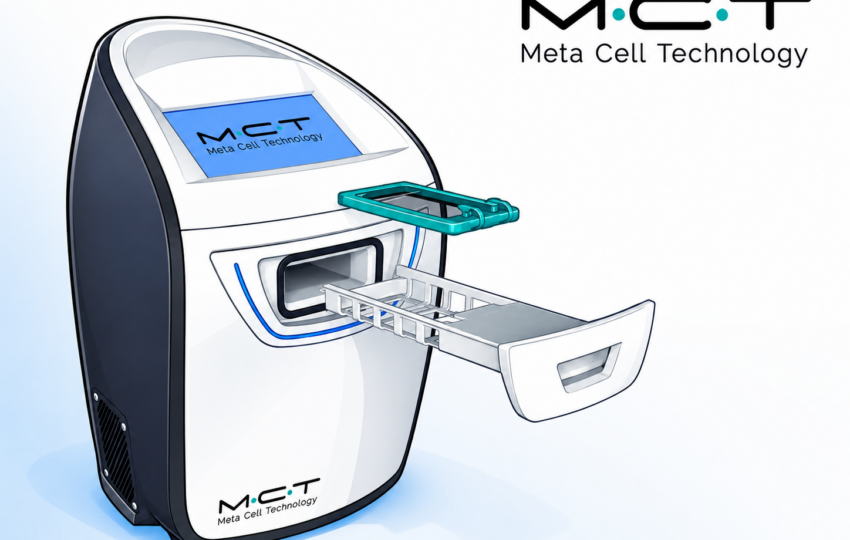
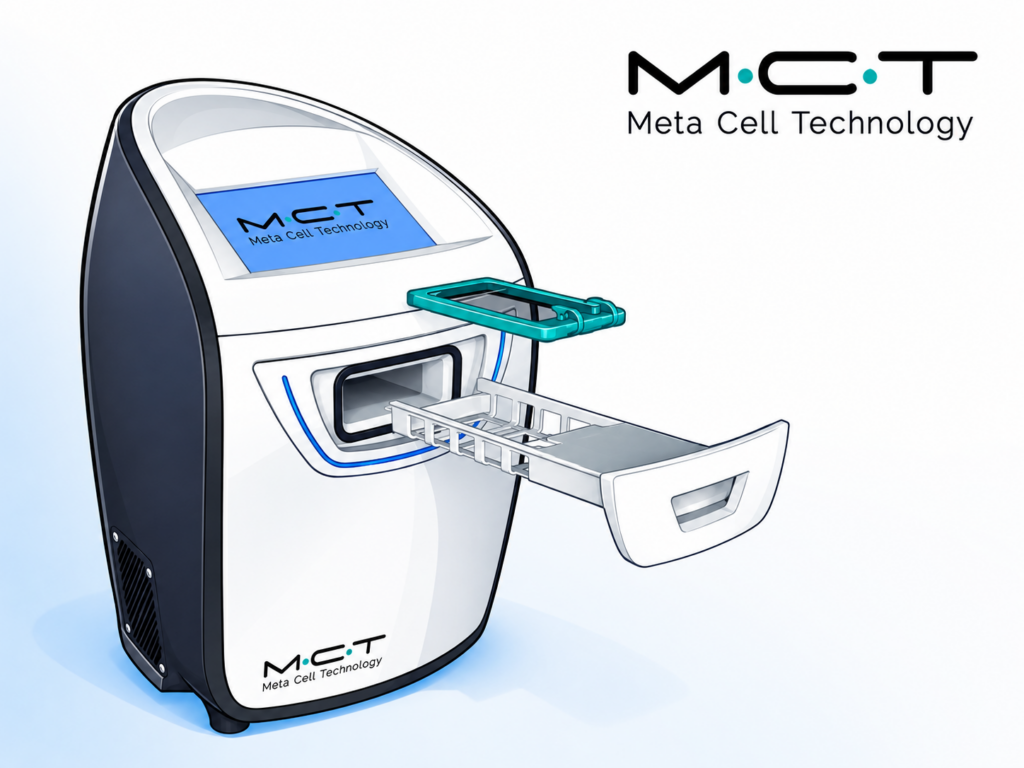
The MCT system is composed of the MCT Unit and MCT Kit, and official MCT information describes it as a system designed to enhance autologous products such as PRP while releasing patient-derived exosomes in a single session through photothermal biomodulation.
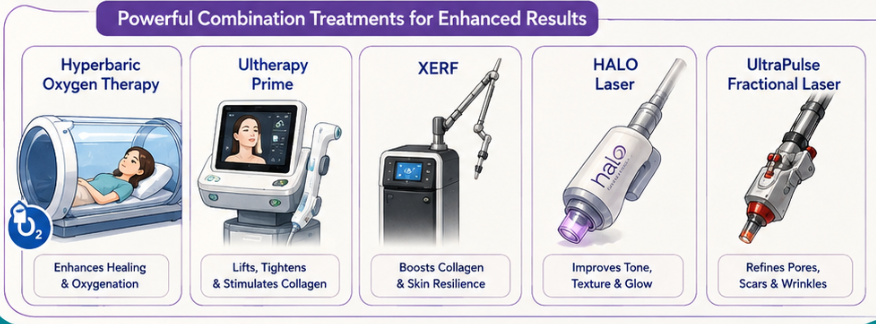
At LABE Plastic Surgery in Songdo, Incheon, near Incheon Airport, MCT MetaCell Korea can be planned as part of a customized skin regeneration program. It may be combined with micro needle manual injection, cannula delivery, hyperbaric oxygen therapy, Ultherapy Prime, XERF, HALO laser, UltraPulse fractional laser, and other energy-based treatments depending on the patient’s skin condition.
MCT MetaCell Korea: What Is the Treatment Concept?
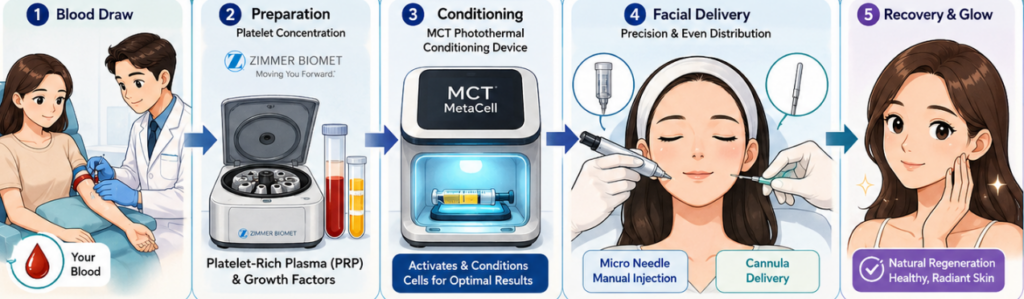
MCT MetaCell Korea can be understood as an autologous regenerative treatment. “Autologous” means that the material comes from the patient’s own blood. The treatment starts with blood collection, followed by separation and concentration of blood-derived components such as platelet-rich and plasma-derived fractions.
The concept of MCT MetaCell Korea is not just to inject PRP. It focuses on how the autologous material is prepared, how it is conditioned, and how it is delivered into the skin.
The MCT Kit is described as a patented single-use device specifically designed for photothermal conditioning of autologous preparations, with its structure designed for light transmission and energy exposure.
For international patients visiting Korea through Incheon International Airport, MCT MetaCell Korea can be considered as part of a regenerative skin care plan during a short stay in Songdo, Incheon.
MCT MetaCell Korea Key Point 1: Zimmer Biomet Kit for Autologous Preparation
The first key point of MCT MetaCell Korea is the preparation process.
A Zimmer Biomet GPS III platelet concentration system can be used to separate and concentrate blood-derived components. Zimmer Biomet describes the GPS III system as processing a fixed volume of PRP that contains over 90% of the available platelets, with a 15-minute processing time and automated separation mechanism.
In clinical explanation, this means MCT MetaCell Korea begins with a structured autologous preparation step rather than using an external or donor-derived product.
The preparation flow can be explained in this way:
| Process | Meaning |
|---|---|
| Blood draw | Autologous blood is collected from the patient |
| Zimmer Biomet kit processing | Platelet-rich and plasma-derived components are separated |
| Buffy coat / plasma selection | Regenerative bioactive fractions are prepared |
| MCT Metacell conditioning | The autologous preparation is conditioned before delivery |
| Delivery planning | Micro needle manual injection, cannula delivery, or combination delivery is selected |
This makes MCT MetaCell Korea different from a simple cosmetic injection. The treatment includes blood-derived preparation, conditioning, delivery planning, and recovery-environment support.
MCT MetaCell Korea Key Point 2: MCT Photothermal Conditioning and Autologous Exosome-Oriented Concept
The second key point of MCT MetaCell Korea is MCT photothermal conditioning.
MCT conditioning can be explained as a process that applies energy to the autologous preparation before it is delivered into the skin. The goal is to create a more regenerative, autologous, exosome-oriented preparation that may support skin recovery and remodeling.
MCT’s official material describes the system as enhancing autologous products such as PRP, SVF, or stem cell concentrates while releasing the patient’s exosomes in a single session.
MCT MetaCell Korea uses autologous blood-derived material and MCT photothermal conditioning to create an exosome-oriented regenerative preparation that may support skin recovery and remodeling.
MCT MetaCell Korea Key Point 3: Micro Needle Manual Injection and Cannula Delivery
The third key point of MCT MetaCell Korea is that the delivery method can be customized.
After the autologous material is prepared and conditioned, it can be delivered through micro needle manual injection, cannula delivery, or a combination of both.
MCT MetaCell Korea With Micro Needle Manual Injection
Micro needle manual injection can be useful when the doctor wants to place small amounts of material into specific areas. This may include fine wrinkles, acne scar areas, pore-dense areas, or localized texture concerns.
Micro needle manual injection allows the physician to control placement area by area. It may be suitable when the goal is precise regenerative stimulation in selected regions.
MCT MetaCell Korea With Cannula Delivery
Cannula delivery can be useful when the goal is broader distribution. A cannula may reduce the number of repeated needle entry points and can help spread the autologous preparation across selected tissue planes.
For full-face skin quality support, MCT MetaCell Korea may be planned with cannula delivery, micro needle manual injection, or both depending on the skin condition.
| Delivery Method | Main Role | Suitable Concept |
|---|---|---|
| Micro needle manual injection | Precise point placement | Fine wrinkles, pores, scars, localized texture |
| Cannula delivery | Broader distribution | Full-face skin quality and regenerative support |
| Combination approach | Balanced delivery | Local precision + global regenerative support |
This flexibility makes MCT MetaCell Korea suitable for customized treatment planning near Incheon International Airport, especially for international patients who want an efficient but individualized regenerative program.
MCT MetaCell Korea Key Point 4: Hyperbaric Oxygen Therapy for Recovery-Environment Support
The fourth key point of MCT MetaCell Korea is the possibility of combining it with hyperbaric oxygen therapy, or HBOT.
Hyperbaric oxygen therapy increases oxygen delivery by having the patient breathe oxygen inside a pressurized chamber. Mayo Clinic explains that HBOT increases oxygen delivery by providing pure oxygen in an enclosed space with higher-than-normal air pressure.
For MCT MetaCell Korea, hyperbaric oxygen therapy can be positioned as recovery-environment support rather than as a direct replacement for the regenerative injection itself.
The concept can be explained like this:
- MCT MetaCell Korea provides autologous regenerative signaling material
- Hyperbaric oxygen therapy supports tissue oxygen availability
- Together, they may help create a better recovery environment
- The effect should be explained as supportive and individualized
This combination can be especially meaningful for patients receiving multiple regenerative or energy-based treatments during a Korea visit near Incheon Airport.
MCT MetaCell Korea may be combined with hyperbaric oxygen therapy to support the recovery environment, but the degree of synergy can vary depending on the patient’s health, skin condition, and treatment protocol.
MCT MetaCell Korea Key Point 5: Combination With Ultherapy Prime, XERF, HALO Laser, and UltraPulse Fractional Laser
The fifth key point of MCT MetaCell Korea is its compatibility with energy-based skin treatments.
Regenerative skin treatments often work best when the skin environment is properly prepared. Energy-based procedures can create controlled stimulation in the skin, while MCT MetaCell Korea can provide autologous regenerative material to support post-treatment remodeling.
MCT MetaCell Korea With Ultherapy Prime
Ultherapy Prime is a microfocused ultrasound treatment with visualization. Ultherapy is FDA-cleared to lift the eyebrow, neck, and under-chin area and to improve lines and wrinkles on the décolleté.
When MCT MetaCell Korea is combined with Ultherapy Prime, the treatment concept can be explained as:
- Ultherapy Prime: layer-based ultrasound lifting stimulation
- MCT MetaCell Korea: autologous regenerative support
- Combination goal: lifting support + regenerative skin quality improvement
This may be considered when the patient has both skin laxity and reduced skin quality.
MCT MetaCell Korea With XERF
XERF is a dual-frequency monopolar RF tightening treatment using 6.78 MHz and 2 MHz energy. Cynosure Lutronic APAC describes XERF as a multifrequency monopolar RF treatment that combines 6.78 MHz and 2 MHz frequencies to deliver energy deeper and where it is needed most.
When combined with MCT MetaCell Korea, XERF can provide RF-based tightening stimulation, while MCT MetaCell supports the regenerative skin environment.
This combination can be considered when the goal includes both tightening and skin quality improvement.
MCT MetaCell Korea With HALO Laser
HALO laser can be considered when the main concerns are tone, texture, pigmentation, pores, roughness, and superficial renewal. Sciton describes HALO as a hybrid fractional laser that delivers both 1470 nm non-ablative coagulation and 2940 nm ablative wavelengths to the same microscopic treatment zone.
After HALO laser fractional stimulation, MCT MetaCell Korea can be used to support the regenerative environment. The concept is not simply “laser plus injection.” It is better explained as:
HALO laser creates controlled fractional stimulation, while MCT MetaCell Korea supports post-laser regenerative signaling and skin recovery.
MCT MetaCell Korea With UltraPulse Alpha Fractional Laser
UltraPulse alpha fractional CO₂ laser can be considered for acne scars, deeper texture, wrinkles, and resurfacing-oriented treatment. Lumenis describes UltraPulse Alpha as a CO₂ fractional laser platform for skin resurfacing, rejuvenation, and scar revision.
Because UltraPulse alpha fractional laser creates a stronger regenerative stimulus than mild skin-care procedures, the recovery environment becomes especially important. In this setting, MCT MetaCell Korea may be used after or around fractional laser treatment to support tissue recovery, dermal remodeling, and skin quality improvement.
The timing should be customized depending on laser intensity, skin sensitivity, downtime tolerance, and the patient’s travel schedule.
MCT MetaCell Korea Treatment Flow
MCT MetaCell Korea can be explained through a structured treatment flow.
- Consultation and skin evaluation
Skin thickness, pores, acne scars, laxity, pigmentation, sensitivity, and previous treatments are reviewed. - Blood draw
Autologous blood is collected from the patient. - Zimmer Biomet kit preparation
The blood is processed to separate selected platelet-rich and plasma-derived fractions. - MCT photothermal conditioning
The autologous preparation is conditioned through the MCT system. - Delivery planning
Micro needle manual injection, cannula delivery, or a combination approach is selected. - Injection procedure
The conditioned autologous material is delivered according to the treatment plan. - Optional combination care
Hyperbaric oxygen therapy, Ultherapy Prime, XERF, HALO laser, UltraPulse fractional laser, or LDM Triple may be considered depending on the treatment goal.
For patients near Incheon International Airport, this process can be planned according to available time, treatment intensity, and recovery expectations.
Who May Consider MCT MetaCell Korea?
MCT MetaCell Korea may be considered for patients who want gradual improvement in skin quality rather than immediate filler-like volume.
Common concerns may include:
- Rough skin texture
- Reduced skin density
- Fine wrinkles
- Pore appearance
- Shallow acne scars
- Post-laser recovery support
- Skin recovery and regeneration support
- Interest in autologous exosome-oriented treatment
- Interest in combination treatment with HBOT or lasers
- Preference for a patient-derived regenerative approach
However, MCT MetaCell Korea may not be enough for severe sagging, deep wrinkles, deep acne scars, or strong pigmentation when used alone. In those cases, combination treatment with Ultherapy Prime, XERF, HALO laser, UltraPulse fractional laser, RF microneedling, BBL HERO, MOXI, or other treatments may be more appropriate.
H2. MCT MetaCell Korea at LABE Plastic Surgery in Songdo Near Incheon Airport
At LABE Plastic Surgery in Songdo, Incheon, MCT MetaCell Korea can be planned as part of a customized regenerative skin program. Songdo is close to Incheon International Airport, which may be convenient for international patients visiting Korea for aesthetic treatment, business travel, or a short stay.
Treatment planning may include:
- Zimmer Biomet kit-based autologous preparation
- MCT photothermal conditioning
- Micro needle manual injection for focal skin quality concerns
- Cannula delivery for broader full-face distribution
- Hyperbaric oxygen therapy for recovery-environment support
- Ultherapy Prime for ultrasound lifting
- XERF for RF tightening
- HALO laser for tone and texture
- UltraPulse fractional laser for scars and resurfacing
- LDM Triple for post-procedure calming care
The important point is customization. MCT MetaCell Korea should be planned according to whether the main issue is texture, pores, wrinkles, scars, laxity, post-laser recovery, or overall regenerative skin quality.
FAQ About MCT MetaCell Korea
Q1. What is MCT MetaCell Korea?
MCT MetaCell Korea is an autologous regenerative treatment concept that uses the patient’s own blood-derived components, Zimmer Biomet kit preparation, and MCT photothermal conditioning to support skin quality and regenerative signaling.
Q2. Why use a Zimmer Biomet kit for MCT MetaCell Korea?
A Zimmer Biomet platelet concentration kit can help separate and concentrate blood-derived components such as platelet-rich and buffy coat fractions. This creates a controlled autologous preparation before MCT conditioning.
Q3. How is MCT MetaCell Korea injected?
MCT MetaCell Korea can be delivered through micro needle manual injection, cannula delivery, or a combination approach. Micro needle manual injection may be useful for precise areas, while cannula delivery may be useful for broader distribution.
Q4. Can MCT MetaCell Korea be combined with hyperbaric oxygen therapy?
Yes. MCT MetaCell Korea can be combined with hyperbaric oxygen therapy as recovery-environment support. However, this should be explained as a supportive strategy rather than guaranteed synergy.
Q5. Can MCT MetaCell Korea be combined with Ultherapy Prime, XERF, HALO, or UltraPulse fractional laser?
Yes. MCT MetaCell Korea may be combined with Ultherapy Prime for ultrasound lifting, XERF for RF tightening, HALO for tone and texture, and UltraPulse fractional laser for scars or resurfacing. The timing and intensity should be customized according to the patient’s skin condition.
Summary: MCT MetaCell Korea Is an Autologous Regenerative Skin Program Near Incheon Airport
MCT MetaCell Korea is not simply a skin booster injection. It is an autologous regenerative treatment concept that includes Zimmer Biomet kit-based preparation, MCT photothermal conditioning, and customized delivery through micro needle manual injection or cannula.
The treatment can be combined with hyperbaric oxygen therapy to support the recovery environment and may also work well with Ultherapy Prime, XERF, HALO laser, and UltraPulse fractional laser when lifting, tightening, tone, texture, scars, or resurfacing are part of the treatment goal.
For patients who want autologous exosome-oriented skin regeneration, improved texture, pores, fine wrinkles, and post-procedure recovery support, MCT MetaCell Korea can be considered as part of a customized regenerative skin program at LABE Plastic Surgery in Songdo, Incheon, near Incheon International Airport.