Density Alpha in Korea is a non-surgical RF lifting treatment for patients who want to improve fine wrinkles, enlarged-looking pores, skin laxity, and overall facial firmness. Many patients look for lifting treatments when the skin feels thinner, the jawline becomes less defined, or pores and fine lines become more visible.
Density Alpha is not a laser treatment. It is based on radiofrequency, or RF energy, which delivers controlled heat into the skin and deeper tissue layers. The official DENSITY information explains that the device transmits 6.78 MHz monopolar and bipolar high-frequency energy to both deep and superficial skin layers, with impedance feedback and a 5-step cooling system.
At LABE Plastic Surgery in Songdo, Incheon, Density Alpha in Korea can be planned according to facial shape, skin thickness, facial fat volume, wrinkle depth, pore pattern, and the degree of skin laxity. The goal is not simply to deliver more energy, but to deliver the right energy to the right layer.

Density Alpha in Korea: What Is Density Alpha RF Lifting?
Density Alpha in Korea is a non-invasive RF skin-tightening treatment. RF energy creates heat within the tissue, and this controlled thermal stimulation may support collagen contraction and gradual collagen remodeling.
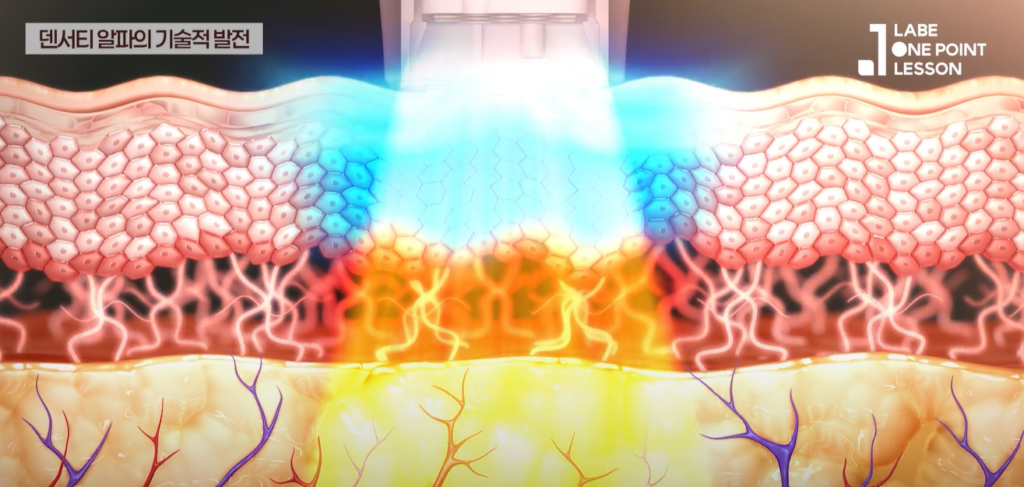
The DENSITY system uses both monopolar RF and bipolar RF. Official Jeisys information describes monopolar high frequency as reaching deeper layers such as the dermis, subcutaneous fat layer, and fascia layer, while bipolar high frequency targets more superficial layers such as the epidermis and upper dermis.
This is why Density Alpha in Korea can be explained as a multi-layer RF lifting treatment. It can be used to approach deeper firmness and superficial texture at the same time.
Density Alpha in Korea Principle 1: Monopolar RF for Deeper Firmness
The first principle of Density Alpha in Korea is monopolar RF energy.
Monopolar RF is useful when deeper facial laxity contributes to an older or heavier appearance. Facial aging is not only a surface problem. Deeper tissue looseness, cheek heaviness, jawline blurring, and reduced skin density can all affect the overall facial contour.
With Density Alpha in Korea, monopolar RF can be used to support deeper tissue tightening and collagen remodeling. This may be especially relevant for patients with mild lower-face sagging, heavier cheeks, or early jawline laxity.
However, deeper energy is not always better. In thin or low-volume faces, energy should be planned carefully so the face does not look more hollow. This is why Density Alpha in Korea should be customized by facial anatomy rather than treated as a fixed shot-count package.
Density Alpha in Korea Principle 2: Bipolar RF for Fine Wrinkles, Texture, and Pores
The second principle of Density Alpha in Korea is bipolar RF energy.
Bipolar RF is more closely related to superficial skin layers. This matters because fine wrinkles, rough texture, and enlarged-looking pores are often related to the superficial dermis and the quality of the skin surface.
Pores are not only caused by sebum. As the dermal support around pores becomes weaker, pores can look stretched or more visible. Fine wrinkles can also become more noticeable when the skin loses dermal density and elasticity.
In Density Alpha in Korea, bipolar RF can help support superficial dermal remodeling. When combined with monopolar RF, the treatment can address both deeper firmness and superficial texture.
This layered concept makes Density Alpha in Korea useful for patients who want to improve:
- Overall skin density
- Fine wrinkles
- Skin elasticity
- Enlarged-looking pores
- Rough texture
- Mild laxity
Density Alpha in Korea Principle 3: 6.78 MHz RF Energy With Impedance Feedback
The third principle of Density Alpha in Korea is 6.78 MHz RF energy with impedance feedback.
Official DENSITY information states that the device delivers 6.78 MHz monopolar and bipolar high-frequency energy to both deep and superficial skin layers. It also explains that impedance feedback measures skin resistance and adjusts energy delivery because each patient’s skin resistance can be different.
This is important because the same energy setting does not always create the same tissue response. Skin thickness, hydration, facial fat volume, previous treatments, and treatment area can all affect RF energy delivery.
For Density Alpha in Korea, impedance feedback helps support more consistent energy delivery. In clinical planning, this means the treatment should be adjusted according to the patient’s skin condition rather than performed with the same settings for everyone.
Density Alpha in Korea Principle 4: Cooling for Comfort and Surface Protection
The fourth principle of Density Alpha in Korea is cooling.
RF lifting needs heat to work, but the skin surface should be protected. DENSITY uses a gas-spraying cooling method with five adjustable cooling levels, and the official product information also describes real-time temperature monitoring and epidermal protection through cooling.
This cooling system can help make Density Alpha in Korea more comfortable and may reduce unnecessary surface heat burden. Patients may still feel warmth, pressure, or brief heat during treatment, but cooling helps support comfort and surface protection.
A balanced explanation is:
Density Alpha in Korea uses RF heat energy for skin tightening, while cooling helps protect the epidermis and improve treatment comfort.

Density Alpha in Korea Principle 5: Alpha Tip for Wider and Deeper RF Energy Delivery
The fifth principle of Density Alpha in Korea is the Alpha Tip.
The Korean DENSITY official information explains that the Alpha Tip is a high-frequency system designed to deliver both monopolar and bipolar RF energy more widely and deeply. It also distinguishes Alpha Tip, High Tip, and Classic Tip, with the Classic Tip delivering only monopolar RF energy.
This means Density Alpha in Korea should be understood not only as a general RF treatment, but as a treatment mode that can use the Alpha Tip concept for broader and deeper energy delivery.
In clinical terms, this may be useful when the patient needs more comprehensive treatment across the cheek, jawline, lower face, or areas where both firmness and texture are concerns. However, wider and deeper delivery still needs careful planning. The treatment should be adjusted according to skin thickness, facial volume, and the patient’s risk of over-treatment.
Density Alpha in Korea for Wrinkle Improvement
Density Alpha in Korea may help improve fine wrinkles by supporting dermal collagen remodeling.
Fine wrinkles often appear when the dermal support structure becomes weaker. RF energy creates controlled heating in the skin, and this thermal stimulation can contribute to collagen contraction and remodeling over time. A clinical review of monopolar RF describes RF treatment as generating controlled heat in dermal layers, stimulating collagen synthesis and remodeling, and promoting tissue contraction.
For patients, this means Density Alpha in Korea should not be understood as an instant surgical lift. It is better described as a gradual skin-tightening and collagen-remodeling treatment.
It may be considered for fine wrinkles around the cheeks, lower face, jawline, and areas where skin elasticity has started to decrease. Deep expression lines, deep folds, or severe skin laxity may require additional treatments such as botulinum toxin, fillers, fractional lasers, skin boosters, or surgical options.
Density Alpha in Korea for Pore Improvement
Density Alpha in Korea may also be considered for pores that look enlarged due to reduced skin elasticity.
Pores can appear larger when the surrounding dermal support becomes weaker. This is different from oily pores caused mainly by sebum or acne-related pores caused by scarring. When pores are related to skin laxity and dermal weakness, RF-based treatment may help improve the surrounding skin support.
With Density Alpha in Korea, bipolar RF can address the more superficial dermis, while monopolar RF can support deeper firmness. This combination may help the skin look smoother and denser.
However, if pores are mainly related to acne scars, deep textural irregularity, or active acne, Density Alpha in Korea may need to be combined with other treatments such as HALO, UltraPulse Alpha, MOXI, PicoWay, RF microneedling, Juvelook, Re2O, or MiraJet Forte.
Density Alpha in Korea for Skin Elasticity and Facial Firmness
Density Alpha in Korea can be useful when the main concern is reduced skin elasticity.
Elasticity loss often appears as mild sagging, soft cheek heaviness, blurred jawline, reduced skin density, and a less firm facial appearance. Because Density Alpha combines monopolar and bipolar RF, it can be planned for both deeper firmness and superficial skin quality.
In patients with a heavy lower face, Density Alpha in Korea may be focused more around the cheeks, jawline, and lower-face laxity. In patients with thin skin and low facial volume, the plan should be more conservative, focusing on skin firmness without excessive deep heating.
The key is customized energy planning. Density Alpha in Korea should be adjusted by facial type, not performed the same way for every patient. recently performed, the energy level and treatment interval should be adjusted carefully.

Density Alpha in Korea at LABE Plastic Surgery
At LABE Plastic Surgery in Songdo, Incheon, Density Alpha in Korea is planned by a board-certified plastic surgeon. This matters because RF lifting results depend on facial anatomy, energy depth, tissue thickness, and facial volume distribution.
LABE Plastic Surgery is located near Incheon International Airport, which can be convenient for international patients visiting Korea for aesthetic treatment, business travel, or transit.
At LABE Plastic Surgery, Density Alpha in Korea can be planned by evaluating:
- Skin thickness
- Facial shape
- Cheek volume
- Jawline contour
- Wrinkle depth
- Pore pattern
- Skin elasticity
- Concern about cheek hollowing
- Pain sensitivity
- Recovery schedule
The goal is to create a natural-looking improvement in skin firmness, pores, wrinkles, and elasticity.
Density Alpha in Korea FAQ
Q1. Is Density Alpha in Korea a laser treatment?
No. Density Alpha in Korea is not a laser. It is a non-invasive RF lifting treatment using radiofrequency energy.
Q2. What energy does Density Alpha in Korea use?
Density Alpha in Korea uses 6.78 MHz monopolar and bipolar RF energy. Official DENSITY information describes the system as delivering both monopolar and bipolar high-frequency energy to deep and superficial skin layers.
Q3. Can Density Alpha in Korea improve wrinkles?
Density Alpha in Korea may help improve fine wrinkles related to reduced skin elasticity and dermal collagen decline. Deep expression lines or deep folds may require combination treatment.
Q4. Can Density Alpha in Korea improve enlarged pores?
Density Alpha in Korea may help pores that look enlarged due to reduced skin elasticity. If pores are mainly caused by sebum or acne scars, other treatments may be needed.
Q5. Why choose LABE Plastic Surgery for Density Alpha in Korea?
LABE Plastic Surgery is located in Songdo, Incheon, near Incheon International Airport. Density Alpha in Korea at LABE is planned by a board-certified plastic surgeon according to facial shape, skin thickness, wrinkle depth, pore pattern, and skin laxity.
Summary: Density Alpha in Korea Is a Multi-Layer RF Lifting Treatment
Density Alpha in Korea is a multi-layer RF lifting treatment using 6.78 MHz monopolar and bipolar radiofrequency energy. Monopolar RF helps address deeper firmness, while bipolar RF supports superficial texture, fine wrinkles, and elasticity-related pore concerns.
The strength of Density Alpha in Korea is not only the RF energy itself. It is the ability to customize energy delivery according to facial shape, skin thickness, wrinkles, pores, skin elasticity, and cheek volume. Impedance feedback and cooling also help support consistent energy delivery and treatment comfort.
At LABE Plastic Surgery in Songdo, Incheon, near Incheon International Airport, Density Alpha in Korea can be considered for patients who want non-surgical RF lifting, wrinkle improvement, pore refinement, and skin elasticity enhancement with individualized planning by a board-certified plastic surgeon.